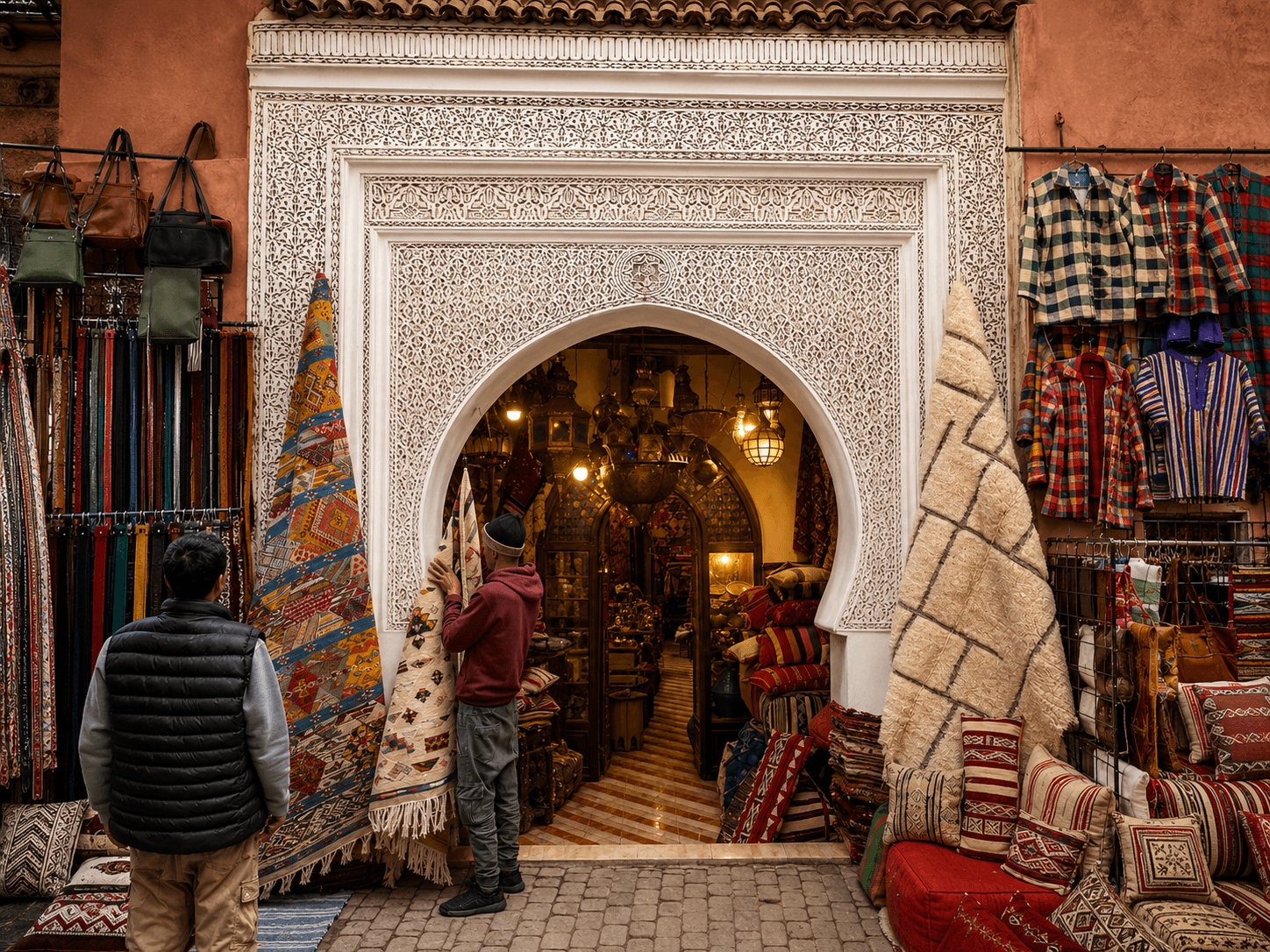
I was four or five when I first visited my grandfather's rug bazaar in Marrakech.
There was this big arch and a wooden door with coloured glass that immediately caught my eye. When I stepped inside, it felt like the whole world opened up: rugs stacked high, lanterns overhead, wood and metal everywhere. It felt endless, like anything could be there.
I didn't grow up in the bazaar. Most of my visits were during school holidays, when we came to Marrakech. For about a year, when I was ten or eleven, we lived in Marrakech, and I got to spend more time there.
Every visit felt like an adventure. I'd go from room to room and peek behind chests, convinced there was always something I had never seen before, even if it had been sitting there for years.
My grandfather also had this lovely habit of handing me a small gift before I left. One visit, it was a small leather wallet. Another time, it was a daadou, a hand drum with a clay body and animal skin stretched across the top. Another time, an oud.
At that age, I didn't understand the rug trade or what the bazaar represented. I only understood the feeling.
It was alive, a little overwhelming, and wonderful.
The Man Behind the Bazaar
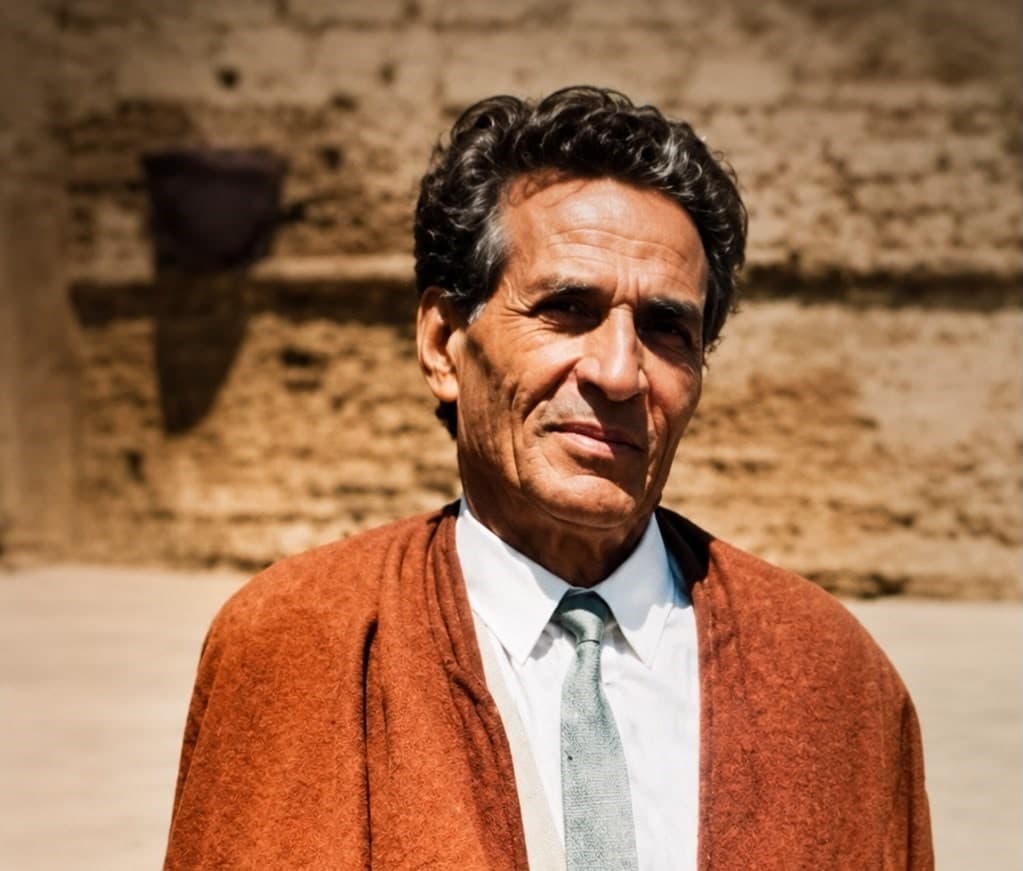
As I got older, I started to see my grandfather differently.
He had a presence that's hard to describe unless you met him. He was immaculately dressed, clean-shaven and always wearing perfume. He carried himself with a quiet confidence.
Almost every day, on his way home from the bazaar for lunch, he'd stop at the butcher and buy what was needed for that evening.
There was rarely a guest list.
Friends, merchants, travellers, customers from that morning — if you crossed his path that day, you might find yourself sitting at his table that evening.
Watching him, I learned that the work wasn't only about things.
It was about relationships, fairness and trust.
Deals were sealed with a handshake. If he shook on it, that was his word.
How My Grandfather Built a Rug Business in Marrakech
As I got older, I began asking more questions.
The bazaar wasn't simply a building full of Moroccan rugs, antiques and handmade objects. What I had seen as a child was the result of years of work, travel and relationships built across Morocco and beyond.
My grandfather took over the bazaar in 1967.
He didn't sit in Marrakech waiting for exceptional pieces to arrive. He travelled to find them and to meet the people behind them.
He sourced work across Morocco and took Moroccan craftsmanship to trade fairs abroad, despite never having gone to school. He couldn't read or write. Instead, he picked up what he needed of different languages along the way and built relationships through honesty, respect and instinct.
For me, that part of his story matters.
The knowledge behind a Moroccan rug has never existed only in books. Much of it has always travelled through people: weavers, traders, families, workshops and generations of experience.
When Exporting Moroccan Rugs Wasn't Simple
There's also a part of the history of the Moroccan rug trade that people rarely hear about now.
Before the 1990s, you couldn't simply take a rug and export it from Morocco. An export licence was required, and in Marrakech only one or two people held one. My grandfather was one of them.
Every rug intended for export first had to be graded at Dar Si Issa, a government office where the piece was examined and classified. Threads were counted, density was measured and the rug was assessed before it could leave the country.
Between the weavers working in the back rooms, the pieces my grandfather sourced across Morocco and the rugs eventually sent abroad, the bazaar became part of a much wider trade in Moroccan craftsmanship.
By its busiest years, around twenty people worked there.
And simply caring for the pieces was a job in itself.
Rugs had to be moved, unrolled, cleaned, aired and exposed to the sun. A bazaar full of handmade pieces isn't a static collection. Wool, leather, wood and metal all need care, particularly when objects may remain in the same building for years.
As a child, I saw rooms full of things.
Only later did I understand how much work was required to keep those things there.
What I Got Wrong About Natural Dyes
There's something else I learned much later.
For years, I assumed that if a Moroccan rug was handmade, the dyes in it must also be natural.
They often aren't.
Synthetic dyes have been used in Moroccan rugs for a long time.
Natural dye materials traditionally available to Moroccan weavers produce a more limited range of colours. Madder, indigo, walnut, saffron, pomegranate and iron can produce beautiful tones, but when you see certain intense, high-key colours in a rug, modern dyes are often part of the story.
And I don't think that's something that needs to be hidden.
I sell synthetic-dyed rugs, and I'm not apologising for them.
A dye that holds its colour is not a flaw. Some of the best pieces I've handled were dyed that way, and the weaving, wool and hand behind them are exactly what they look like.
A dye that bleeds or fades badly is a real problem.
That's the distinction worth caring about.
Not simply natural versus synthetic.
What I won't do is let someone believe they're buying a plant-dyed rug when the evidence doesn't support that claim.
Nobody should feel bad about the rug on their floor. They should just never have been lied to about it.
That's why my listings say what the individual piece can support and stop there.
The Marrakech Bazaar Is Still There
The bazaar is still standing today.
The name is still on it:
Bazar Berber, Fabrication de Tapis.
My mom runs it now.
Rugs aren't woven inside the building anymore, but every pouf and every pillow I sell is made there by her.
Same rooms.
Same building.
Same door with the coloured glass.
When one of those pieces ships out to you, it started in the building I used to run around in as a kid.
That connection matters to me because Loom & Hearth isn't something I invented after discovering Moroccan rugs online.
These objects were around me before I knew what provenance, pile, knot density or natural dye meant.
I learned the technical language later.
The relationship came first.
What My Grandfather Taught Me About Sourcing Moroccan Rugs
Looking back, I understand that what made my grandfather's Marrakech rug bazaar special wasn't any single rug or object.
It was the care behind the decisions.
The respect for the people who made the pieces.
The relationships built over decades.
And the understanding that your reputation matters long after a particular sale has been forgotten.
Those are the values I try to carry into the way I source Moroccan rugs today.
My goal isn't simply to sell Moroccan rugs.
It's to keep the craft in front of people and to put each piece with someone who will value it.
That also explains why buying a rug from me works the way it does.
You reserve a piece and your card is authorised, not charged. Within 72 hours, I photograph that exact rug in daylight and send you the pictures.
You only pay once you've seen it and approved it.
Then it ships from Casablanca and reaches you in five to ten days, with free shipping on orders over $150.
A handshake used to be enough.
This is the closest thing I can offer you from a distance.
You can see the pieces currently available in the Moroccan rug collection.